








There's a visual in Dr. Itisha Nagar's mind — etched in memory; of her grandmother's
hands, warm and reassuring. It's one of those childhood moments that seems small at the
time but grows in significance with the years, shaping the way you see the world, the
way you move through it. For Dr. Itisha, that warmth became a compass, pointing toward
what matters most: authentic relationships, genuine connection, and the courage to show
up as yourself in a world that often asks you to be someone else.
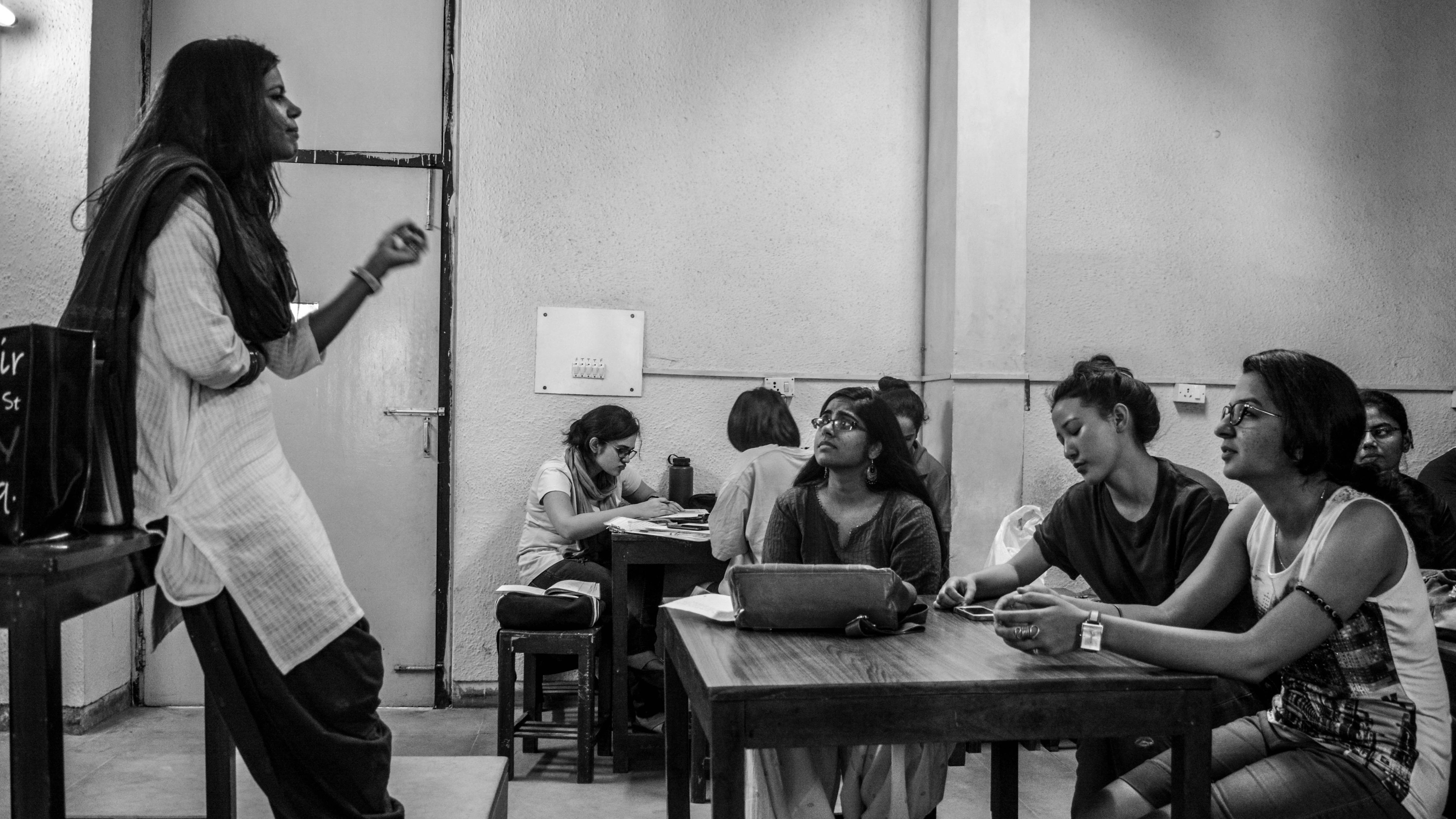
Today, Dr. Itisha Nagar is a psychologist who worked as an assistant professor at Delhi
University's Kamala Nehru College for close to a decade, and now has a deeply engaged
following online. But her journey to this point wasn't a linear climb up a career
ladder—it was something more profound. It was, as she describes it, a process of
"becoming who I always was."
And psychology, her profession, became the vehicle that enables it on the daily. Her
work didn't create her authentic self; it gave her the language and framework to finally
recognise and claim it.
Purpose, By Pure Chance
Like many great love stories, Dr. Itisha’s relationship with psychology began almost by
chance. In high school, she was a science student. Not because she was particularly
passionate, but because that's what "smart students" did. It was expected.
But there was psychology, sitting quietly in her class schedule. "While I could cope up
and do really well, it was really the psychology classes that made me feel alive in a
way that physics, chemistry, biology didn't," she reflects. The discussions about
learning, memory, personality, motivation, and emotion resonated with something deep
inside her. "A lot of my decisions are emotional decisions in life. If I felt happy,
there were no two ways about it."
She then went ahead to focus on securing a spot in a good undergraduate psychology
program. It was a decision that would define everything that followed because it aligned
with who she actually was. Sometimes the most revolutionary thing you can do is choose
happiness over expectation.
Shedding to Grow
The path through psychology education, however, came with its own set of myths. Perhaps
the cruelest was the idea that as a professional, she didn't need mental health support
herself. That she should be, as she puts it, an "empathy ki dukaan" for everybody. "How
much did I have to unlearn that!" she says.
The realisation came slowly: Learning self-care wasn't indulgent, it was survival. So
was learning to set boundaries, something particularly challenging for women socialised
from birth to say yes, to accommodate, to fold themselves smaller to make room for
others.
"As a woman, I'm learning to say no without shame, without guilt," she shares. "And that's a new experience for me"
Explore Itisha Nagar’s WorkBut here's what makes Dr. Itisha’s understanding of boundaries is
revolutionary: she sees them not as walls but as foundations for healthier love. "Once
you realise that not having boundaries not only hurts you but also the other person, it
doesn't become difficult to have those in the first place." She also learned to
distinguish between the people worth pushing her boundaries for: "These are people who
would do the same for me”.
The Personal is Political (and Psychological)
What sets Dr. Itisha apart isn't just her academic credentials or her years in the
classroom. It's her refusal to perform the lie that psychology can ever be neutral,
objective, separate from the messy reality of power and oppression.
Her recent research examines the experiences of late-diagnosed Indian women with
Attention Deficit Hyperactivity Disorder (ADHD), focusing on gender-specific
challenges—work that reflects her bone-deep commitment to understanding how power
structures don't just shape society, but colonise our inner lives, telling us what's
normal and what's deviant, who deserves care and who deserves judgment.
"That's a myth. Psychology doesn't ask us to be objective," she says, her voice firm
with conviction. Instead, she practices what she calls "being of a certain perspective
without becoming it". This is about the ability to immerse yourself in understanding
without drowning, to hold someone else's pain without losing yourself to it.
Her psychology is deeply personal and subjective, shaped by her experiences as a woman
navigating a world where, as she puts it,
"my physical, psychological safety depends on how a man defines himself; my financial safety, my status in society in terms of the jobs, the glass ceilings that exist out there, whether I'll be safe walking on the street or not, my emotional well-being—everything, all of that depends on how we raise our men."
Explore Itisha Nagar’s Work
This isn't academic theorising. Its lived reality transformed into scholarly inquiry and
public discourse. In her TEDx talk at IIM Sambalpur, she shared a deeply personal
narrative on identity, difference, and collective healing, reflecting on her journey as
a female child growing up in a society structured by patriarchal norms and expectations.
She challenged the very idea of "abnormality," reframing it not as truth but as a
construct of power.
"You don't become a feminist because you read a book," she says. "Your experiences, your
pain makes you a feminist." And her feminism isn't the sanitized, corporate-friendly
kind. It's the kind that talks about caste, about class, about all the intersecting
systems of oppression that shape whose voice matters and whose doesn't.
Stories as Sanctuary
Ask Dr. Itisha about the heart of therapeutic work, and she'll tell you about stories as
an approach to thriving. "We need for life to make sense," she explains, invoking Viktor
Frankl's Man's Search for Meaning. We're meaning-making creatures, desperately searching
for the thread that connects our scattered experiences into something coherent. "We're
looking for a moral of the story, for closures, for endings, for things to be tied
up."
But storytelling in therapy isn't just about imposing narrative order on chaos. It's
about creating what she calls, with devastating precision, "a resting place for our
pain." Unlike defense mechanisms that protect us by denying reality—repression,
projection, displacement—stories allow us to hold our pain in a form that's bearable.
The kind that is shaped rather than raw and more acknowledged than denied.
When asked about the moments of uncertainty, burnout, and doubt in her journey, Dr.
Itisha doesn't point to professional setbacks or academic challenges. "My childhood,"
she says simply. "People say adulting is so hard; please try childhood in an extremely
dysfunctional family."
As an adult, at least you have choices, resources, some measure of control. But as a
child? You're at the mercy of forces you can neither understand nor escape.
Her survival tools were simple: study, music, radio. "I studied the hell out of my
life," she says. That childhood forged her understanding of healing in many ways she’s
grown to understand.


Owning Her Inner Landscape
If there's a through-line in Dr. Itisha’s story, it's this steady, hard-won progression
toward taking up space: emotional, intellectual, and space in her own sense of self. "I
own my emotional landscape that has always existed. That's the change. I am occupying
more space by myself."
"I've become unashamed about my emotional depth," she says, and there's power in that
present-tense verb. Not "I am unashamed" as if it's a fixed state, but "I've become",
acknowledging the work, the process, the daily choice it requires. Perhaps most
significantly: "Oppressive voices are not living rent-free in my own self." Not
completely gone and she's honest enough to provide the caveat.
This hasn't been without cost. She talks candidly about the internal struggle of sharing
authentic thoughts publicly with the voice that still is based on external perception.
"I was someone who was chained, caught up psychologically, as we all are, by 'log kya
kahenge' (what will people say), society, shame, others, their needs, their wants from
you as a woman more specifically."
Now, she's learned to balance her truth with what she calls refinement. To create
pockets of radical honesty in spaces that feel safe—her classrooms, her therapy
sessions—while being more measured in public forums. "I play on the inside," she
explains. "And I play when there is safety, such as my classrooms. But in public, I'm
responsible, considerate, and refined in my thoughts."
On the outside, she's certain she's been labeled "too much of a feminist," the "wrong
kind" of feminist. Opportunities have likely passed her by because of what she says,
what she challenges. "I would never come to know that, and that's okay," she says
nonchalantly. "By being my authentic self, I automatically get aligned with people who
would be open and encouraging of the conversations I bring to the table."
Success, From the Inside Out
Ask her what success means, Itisha says: "Success to me means fulfilling my own
potentials, having good, authentic relationships, having humor and peace in the day, and
the resilience to overcome problems that life throws one's way."
It's a definition that would have been impossible for her younger self to articulate
because she hadn't yet given herself permission to know it. Success, in this framing,
isn't about external validation or meeting someone else's standards. It's about
alignment between who you are and how you live, and between your interior world and your
exterior actions.
"There is a continuity of self that I see," she explains. Not a transformation, but an
unbecoming of everything that wasn't truly her — the conventional good girl, the
accommodating woman, the objective professional, the person who said yes when she meant
no.
A Question to Carry Forward
As she prepares to wrap up her thoughts, Dr. Itisha circles back to where her story
began and offers not advice but an invitation, a question to sit with: "If social
relationships were a currency—authentic, good, warm, genuine, healthy relationships were
a currency—how rich would you be, or how poor would you be, and why?"
It's the kind of question that stops you mid-scroll. Because in the end, Dr. Itisha
Nagar's journey reminds us that the measure of a life well-lived isn't found in degrees,
publications, followers or any of the other external markers we've been taught to chase.
It's found in the quality of our connections and the authenticity of our presence and in
our ability to show up, fully and honestly, as ourselves.
It's about looking in the mirror and finally, finally, seeing yourself clearly. And then
having the courage to live that truth out loud. The person your grandmother or anyone
who you hold dear always knew you were.
If You’re Walking a Similar Path
For aspiring psychologists, therapists, educators, or simply anyone trying to live more
authentically:
"The work isn't about becoming someone new. It's about having the courage to be who you already are, beneath all the expectations and shame or guilt. Build genuine relationships because that sustains us through the difficult work of becoming ourselves. Most importantly: trust that beneath all the layers you've accumulated to survive and to fit in, there's someone worth knowing"
Explore Itisha Nagar’s Work